


There are parts of healthcare that patients rarely see. No one walks into a clinic thinking about payer enrollment forms or authorization portals. They think about pain, answers, healing, maybe a little hope.
And yet, behind many smooth patient visits sits a quiet administrative engine. When it works, no one notices. When it doesn’t, everything starts to wobble.
Two of the most important pieces of that engine are credentialing in medical billing and prior authorization.
They sound dry. Almost designed to be ignored. But they decide whether providers get paid, whether care gets delayed, and whether front-desk staff end the day drained or merely tired. There’s a difference.
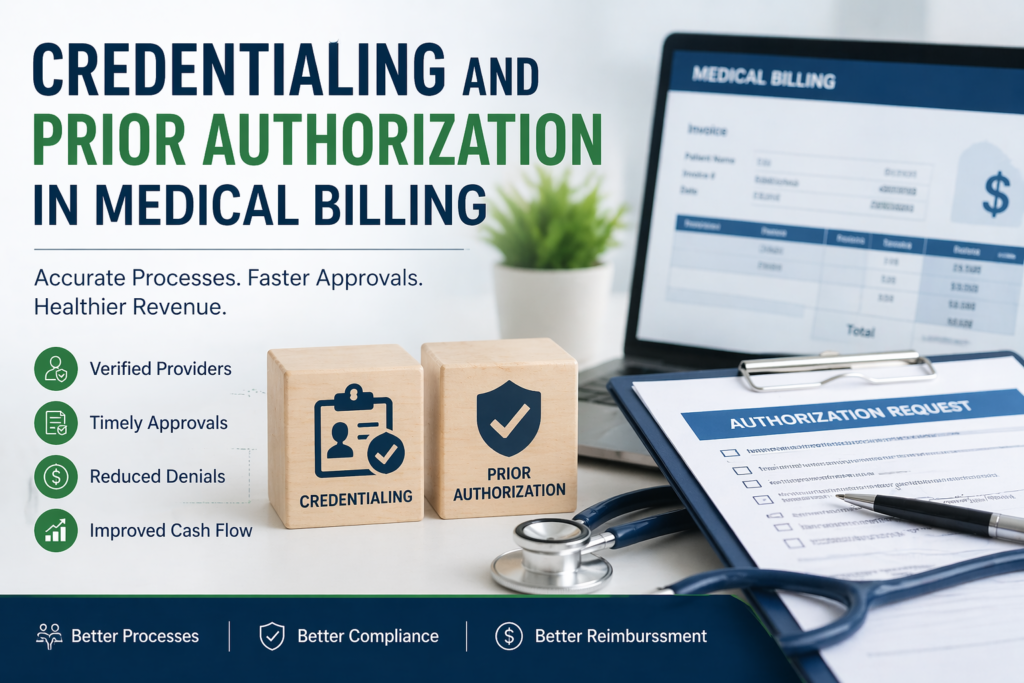
The short answer: Credentialing is the process of verifying a provider’s qualifications and enrolling them with insurance networks so claims can be reimbursed properly.
Without completed credentialing, a physician may treat patients all week and still face denied or delayed payments. Not because the care was poor. Because the paperwork was incomplete, outdated, or still sitting in a queue somewhere.
Credentialing often includes:
It is not glamorous work. But neither are brakes on a car, until the road turns.
Practices that manage this well tend to protect revenue before problems begin. Practices that treat it as an afterthought often learn the expensive version of the lesson later.
For clinics looking to simplify the process, professional medical billing services can help reduce delays and administrative strain.
Bottom line first: delayed credentialing often means delayed cash flow.
A new provider joins the practice. Everyone feels optimistic. Schedules fill quickly. Patients are booked. Then someone notices claims can’t be submitted correctly because enrollment with a major payer is still pending.
That moment tends to feel longer than it is.
Revenue pauses. Staff scramble. Patients ask confusing billing questions that no one enjoys answering.
Proper credentialing helps prevent:
It also helps growth feel like growth instead of chaos.
Prior authorization is the insurer’s approval required before certain medications, tests, procedures, or treatments are covered.
The practical truth? It is a checkpoint.
Sometimes it confirms medical necessity. Sometimes it slows care in ways that feel unnecessary. Often it is both, depending on the case and the day.
Common services requiring prior authorization include:
When authorization is missed or submitted incorrectly, claims may be denied after services are rendered, which is a particularly frustrating kind of preventable problem.
The Centers for Medicare & Medicaid Services continues to emphasize administrative simplification, and for good reason. Excess friction in healthcare rarely stays in one place.
This part deserves honesty.
Administrative delays are not just spreadsheet issues. They reach real people.
A patient waiting for imaging may already be anxious. A parent waiting for a child’s medication approval may be exhausted before breakfast. Even short delays can feel large when health is involved.
Efficient prior authorization processes help practices:
When handled well, patients often never notice. That is usually the sign of good operations.
Insurance verification services are often the first checkpoint in the revenue cycle. They confirm active coverage, plan benefits, copays, deductibles, and whether authorization may be required.
In plain terms: they catch problems early.
That matters because many downstream billing issues begin upstream. Wrong member ID. Inactive policy. Specialist not covered. Authorization needed but not flagged.
Those small misses become larger messes later.
Practices that prioritize insurance verification services often see fewer surprises, cleaner claims, and calmer front-desk conversations. Calm is underrated.
These processes are different, but connected.
A provider may need to be properly enrolled before some payers approve treatment requests. Incorrect provider identifiers can delay authorizations. Missing payer setup can create billing confusion after care is delivered.
So while many offices separate these tasks into silos, revenue does not experience silos. It experiences outcomes.
That is why integrated medical billing services tend to outperform patchwork systems built on memory, sticky notes, and heroic staff effort.
Heroics are admirable. Systems are kinder.
The direct answer: it depends on volume, staffing, and tolerance for administrative complexity.
Small and growing practices often discover that credentialing and prior authorization consume more hours than expected. Experienced employees end up buried in portals, phone calls, resubmissions, and payer follow-ups.
Outsourcing can make sense when:
Reliable partners can manage recurring tasks while internal teams focus on patients and operations.
That shift can feel less dramatic than hiring another provider, but sometimes it changes the business more.
Not all support is equal.
Strong billing support usually means proactive communication, consistent follow-up, transparent reporting, and someone noticing issues before month-end. It means understanding that every unresolved enrollment or pending authorization has a cost.
Practices exploring outside help often look for teams that can support:
That broader support tends to lead to fewer handoff errors and greater continuity.
For practices seeking a tailored approach, Concierge Practice Solutions offers services designed to reduce administrative burden while strengthening collections.

Credentialing and prior authorization rarely get applause. They happen in the background, where many essential things live.
But they shape revenue, patient access, staff morale, and growth readiness more than many realize.
When these systems are steady, a practice can breathe a little easier. Claims move. Patients get answers sooner. Teams spend less time apologizing for avoidable delays.
And that may be the quiet goal underneath all operational work: fewer unnecessary obstacles between care delivered and care supported.
Sometimes progress looks dramatic.
Sometimes it looks like nothing went wrong today.