


Few things create quieter anxiety in a healthcare practice than payments that simply… stop arriving on schedule.
Not dramatic at first. Just… lingering. Claims are sitting untouched for weeks. Staff is checking aging reports with a little more tension every Monday morning. Providers are noticing that despite full schedules and busy exam rooms, revenue somehow still feels unpredictable. A little thinner than it should be.
And honestly, this happens more often than many practices admit.
Medical accounts receivable management rarely gets discussed with the same urgency as patient care or staffing shortages, but it quietly shapes the financial health of almost every healthcare organization. Sometimes in ways that aren’t obvious until the pressure builds. Slowly. Then all at once.
That’s where thoughtful receivables management starts to matter — not as a buzzword, but as a practical, steady process that keeps practices stable enough to focus on patients instead of unpaid balances.
At its core, medical accounts receivable management is the process of tracking, following up on, and collecting payments owed to a healthcare practice.
Simple definition. Complicated reality.
It includes insurance claims, denied reimbursements, patient balances, aging accounts, payment posting, and all the small administrative moments that happen between a patient visit and an actual payment arriving in the bank account.
And unfortunately, healthcare billing rarely moves in a straight line.
Claims get delayed for minor coding errors. Insurance verification slips through the cracks. A payer requests additional documentation three weeks later. A patient changes insurance plans mid-treatment, and nobody notices until the denial arrives. Tiny things. But tiny things stack up.
The revenue cycle management services offered by Concierge Practice Solutions are designed to help practices untangle those delays before they start affecting long-term cash flow.
Because aging claims have a habit of becoming invisible. Then expensive.
A claim sitting unpaid for 90 or 120 days is rarely just “one unpaid claim.”
Usually, it represents interrupted workflows, overworked staff, and systems that became reactive instead of proactive somewhere along the way.
According to the Healthcare Financial Management Association, delayed reimbursements continue to be one of the biggest operational pressures facing healthcare organizations. And the frustrating part is that many denials are technically preventable.
That word — preventable — tends to sting a little.
Not because the staff is careless. Quite the opposite, actually. Most front-office teams are juggling an exhausting number of responsibilities at once. Phones ringing. Prior authorizations. Scheduling changes. Patients needing help at the desk while insurance portals freeze for the third time that day.
Things slip. Humans get tired.
Receivables management works best when it removes pressure instead of adding more of it.
And that distinction matters.
Most accounts receivable issues come from small operational gaps repeating quietly over time.
A missing modifier here. Eligibility verification skipped there. Delayed follow-up after a denial because the billing team is already overwhelmed with older accounts.
None of these mistakes feels catastrophic in isolation. Together, though, they create a kind of financial drag that slowly affects the entire practice.
This is why many healthcare organizations eventually explore outsourced accounts receivable services. Not because they want less control, but because internal teams often need breathing room.
There’s a noticeable difference between a practice that occasionally checks AR reports and one that actively manages receivables every single week with clear workflows and accountability.
One feels stable.
The other feels constantly behind.
The short answer? Faster follow-up and fewer forgotten claims.
But the longer answer is more human than technical.
When receivable solutions are working properly, practices stop spending so much emotional energy chasing payments. Staff members aren’t stuck making uncomfortable collection calls all day. Providers don’t feel pressure every time payroll approaches. Leadership can actually plan instead of reacting month to month.
Good AR management creates predictability. And predictability, oddly enough, lowers stress across an entire organization.
Some improvements are operational:
Others are less measurable but equally important.
People stop carrying financial anxiety into every conversation.
That shift changes the atmosphere of a practice more than many realize.
Here’s something many practices discover too late: submitting claims is only half the job.
Following up matters just as much.
Insurance denials are incredibly common in healthcare billing. The Centers for Medicare & Medicaid Services continues to emphasize accuracy, compliance, and documentation standards that evolve constantly. Which means even experienced teams can struggle to keep pace.
The problem isn’t necessarily receiving denials.
The problem is allowing denied claims to sit unresolved for weeks because nobody has time to investigate them properly.
That’s where structured receivable solutions become valuable. Especially when they include:
AR reports should not become “end-of-month surprises.” The healthiest practices review aging trends continuously and address issues early before balances spiral outward.
Some claims simply require persistence. Appeals. Documentation resubmission. Clarification calls. It’s tedious work sometimes. Quietly tedious.
But recoverable revenue is still revenue.
Strong accounts receivable management often begins before a patient is even seen.
Eligibility verification, accurate demographic collection, and pre-authorizations reduce downstream billing problems dramatically. Which is why integrated support systems matter more now than they did even a few years ago.
Automation has improved healthcare billing in meaningful ways. There’s no denying that.
Modern billing platforms can flag missing information, automate reminders, and identify denial trends faster than manual systems ever could. Helpful tools. Necessary, honestly.
Still, technology alone rarely fixes unhealthy receivables management.
A practice can have excellent software and still struggle with aging claims if workflows remain inconsistent or communication breaks down between departments.
That’s the uncomfortable reality many healthcare leaders eventually face.
The strongest AR systems combine technology with human oversight — people who understand payer behavior, recognize denial patterns, and know when small billing issues are becoming larger operational problems.
There’s experience involved in that. Pattern recognition. A certain instinct that only develops after years inside healthcare administration.
For many independent practices, outsourcing becomes less about cost reduction and more about sustainability.
Internal teams are already stretched thin. Burnout in healthcare administration is very real, even if it’s discussed less openly than clinical burnout.
Sometimes, the most practical decision is allowing outside specialists to manage follow-up, denial resolution, and aging account recovery while staff refocuses on patient care and day-to-day operations.
The support team at Concierge Practice Solutions works with practices that need exactly that kind of operational relief — structured billing support that feels collaborative instead of transactional.
Because healthcare finances are personal for providers. They always have been.
A struggling cash flow doesn’t just affect spreadsheets. It affects hiring decisions, staffing morale, patient experience, and long-term growth. Sometimes, even confidence.
And that emotional layer tends to get overlooked in conversations about medical billing.
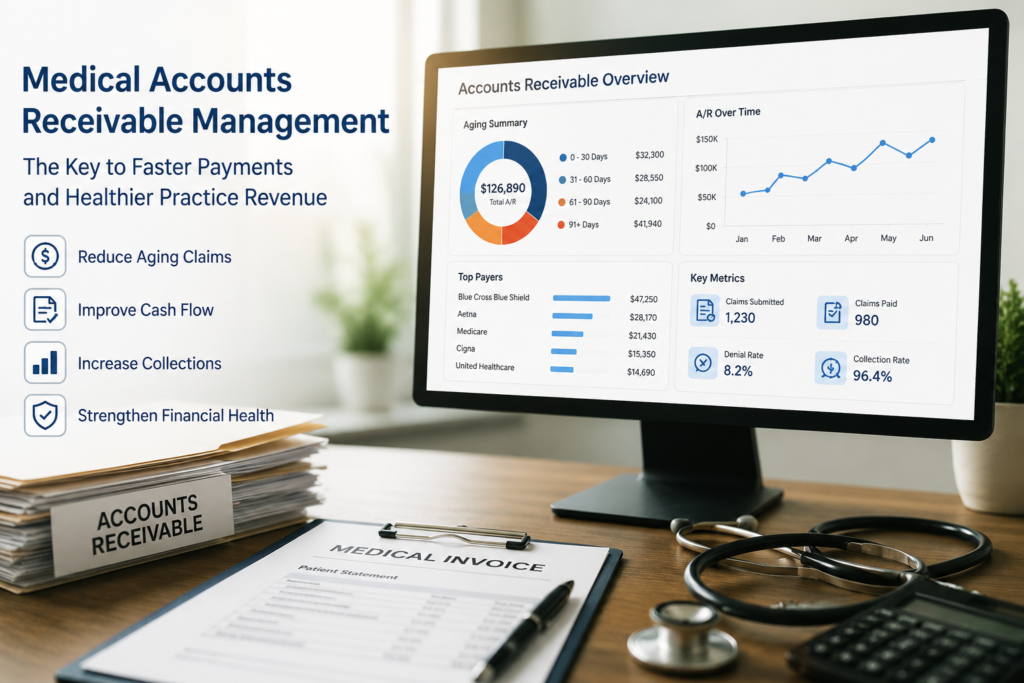
Medical accounts receivable management is not simply about collecting unpaid balances faster.
It’s about creating stability inside a healthcare practice that already carries enough uncertainty.
When receivables are monitored carefully, claims are followed consistently, and billing systems work the way they should, something subtle changes. Practices breathe easier. Decisions become less reactive. Teams stop feeling like they’re constantly catching up.
That kind of operational calm is difficult to quantify.
But it matters.
Especially in healthcare, where administrative strain quietly touches almost every part of the patient experience.
And sometimes, the healthiest revenue cycle isn’t the one with the most aggressive collections strategy. It’s the one built on consistency, clarity, and steady follow-through — the unglamorous work that keeps good practices financially healthy for the long run.