


A practice can appear healthy on the surface while something very different is happening behind the scenes.
The schedule stays full. Providers are busy. Staff members move from patient to patient without much breathing room. By all outward appearances, the practice is doing well.
And yet, the numbers tell a different story.
Revenue feels inconsistent. Accounts receivable keep creeping upward. Denials seem to appear in waves. Some months look healthy; others leave practice owners quietly wondering where the money went.
Often, the issue is not a lack of patients.
It’s a lack of visibility.
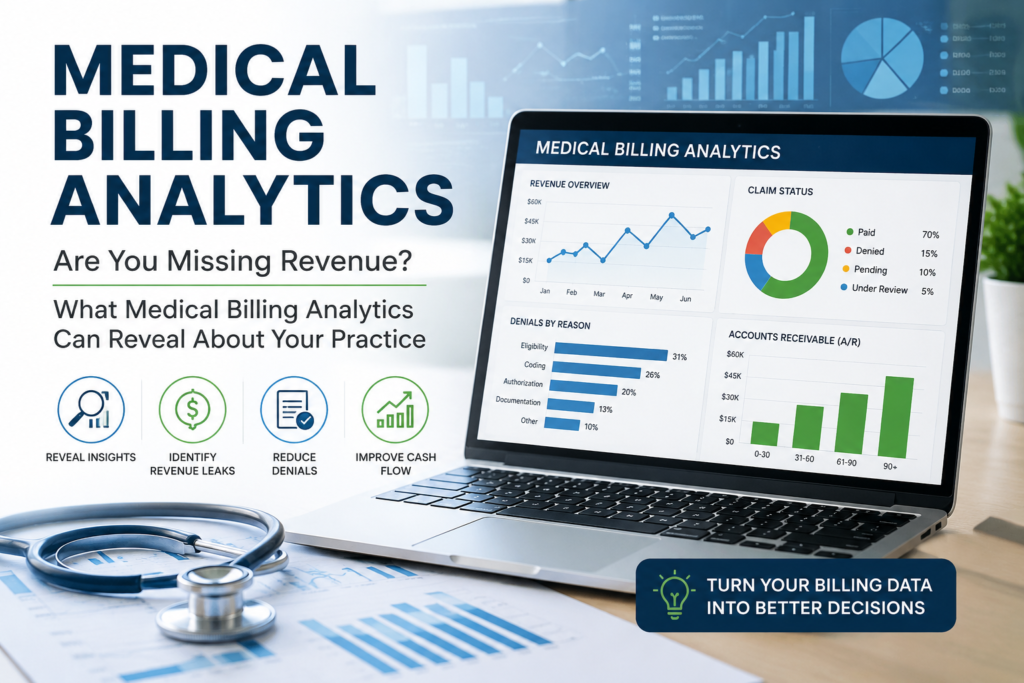
Medical billing analytics gives practices something many have been operating without for years: a clear view of what is actually happening beneath the surface.
At its core, medical billing analytics is the process of collecting, analyzing, and interpreting billing data to understand the financial health of a healthcare practice.
Instead of simply submitting claims and waiting for payments, analytics examines patterns hidden within the revenue cycle. It answers questions such as:
Those answers matter. Quite a bit.
According to the Healthcare Financial Management Association (HFMA), data-driven revenue cycle management has become essential for maintaining financial stability as reimbursement models continue to evolve.
In other words, intuition alone no longer carries a practice very far.
The short answer? Small problems rarely announce themselves.
Revenue loss in healthcare is often quiet.
An insurance eligibility error here. A coding inconsistency there. A handful of denials that never make it through the appeals process. None of these issues seems alarming on its own.
But healthcare finance has a way of turning small inefficiencies into expensive habits.
A practice might lose thousands of dollars each month simply because denied claims are not tracked by payer category. Another practice may discover that patient balances remain unpaid because statements are being sent too late.
Without regular billing analysis, these trends remain invisible.
Invisible problems are difficult to fix.
Billing data speaks constantly. The challenge is learning how to listen.
An increasing denial rate often points to issues occurring long before a claim reaches an insurance company.
Incorrect patient demographics, incomplete documentation, authorization failures, or eligibility verification gaps frequently originate during patient intake.
Practices that consistently monitor denial trends can identify these weak points early.
Organizations that invest in stronger front-end processes often experience fewer denials and improved cash flow. Practices interested in strengthening these workflows can benefit from reviewing comprehensive medical billing and revenue cycle management services designed to address issues across the entire billing cycle.
Days in Accounts Receivable (A/R) remains one of the most important financial indicators in healthcare.
If A/R days continue to rise, reimbursement delays usually occur somewhere in the process.
Perhaps claims are sitting in work queues too long. Maybe follow-up activities are inconsistent. Occasionally, aging accounts simply accumulate because staff members are overwhelmed.
That last scenario is surprisingly common.
Healthcare teams rarely lack dedication. More often, they lack time.
Monitoring A/R trends through medical billing analytics helps practices prioritize collections before outstanding balances become difficult to recover.
Not all payer contracts perform equally.
Some insurance carriers consistently reimburse more slowly than others. Certain plans may underpay specific procedures. Others generate disproportionately high administrative burdens.
Without analytics, these differences remain hidden inside spreadsheets and monthly reports.
Detailed billing data allows practices to compare payer performance objectively and determine whether contract renegotiation may be necessary.
Sometimes the numbers tell a story nobody expected.
The greatest value of analytics is not simply identifying problems.
It is helping leaders make better decisions.
When practice owners understand exactly where revenue is being generated—and where it is being lost—they gain the confidence to plan strategically rather than react constantly.
Medical billing analytics supports financial decisions by helping practices:
Something is reassuring about replacing uncertainty with evidence.
Running a medical practice already involves enough unknowns.
Financial performance should not be one of them.
Every specialty differs, but several core metrics deserve regular attention.
This measures how many claims are accepted on first submission without edits or corrections.
A declining clean claim rate often signals workflow issues, coding inaccuracies, or documentation gaps.
Tracking denials by payer, reason code, and provider helps practices uncover recurring obstacles before they affect overall revenue.
This metric reveals how effectively a practice collects revenue it has legitimately earned.
Consistently low collection rates deserve immediate investigation.
High A/R days frequently indicate follow-up delays, payer inefficiencies, or internal process bottlenecks.
The Centers for Medicare & Medicaid Services (CMS) also emphasizes accurate documentation and claims submission practices as critical components of revenue cycle performance.
Many practices reach a point where internal teams simply cannot devote enough time to deep financial analysis.
That is not failure.
It is capacity.
When reporting remains inconsistent, denials continue increasing, or financial performance feels unpredictable despite strong patient volume, outside expertise can provide clarity.
Experienced revenue cycle specialists bring dedicated reporting tools, benchmarking insights, and ongoing analysis that internal teams often struggle to maintain while managing daily operations.
More importantly, they create space.
Space for providers to focus on patients instead of spreadsheets.
A full waiting room does not always translate into a healthy bottom line.
Sometimes revenue is slipping away quietly, hidden inside claim trends, denial patterns, aging accounts, or overlooked payer issues.
Medical billing analytics shines a light on those blind spots.
The practices that consistently analyze their billing data are not simply collecting more revenue. They are making smarter decisions, reducing uncertainty, and building stronger financial foundations for the future.
And in healthcare, where change rarely slows down, that kind of clarity is worth paying attention to.
Ready to Gain Better Visibility Into Your Revenue Cycle?

If your practice is struggling with denials, inconsistent cash flow, or limited financial reporting, partnering with experienced billing professionals can help uncover missed revenue opportunities.
Learn how Concierge Practice Solutions delivers customized revenue cycle management and analytics services designed to improve financial performance and support long-term practice growth.