


There’s a particular kind of exhaustion that settles into a medical practice after the same claim comes back denied for the third time.
Not dramatic exhaustion. Just quiet frustration.
A front-desk coordinator is staring at a screen a little too long. A billing specialist is digging through notes that should have been verified days earlier. A physician is wondering why revenue feels unpredictable even during fully booked weeks.
And more often than people realize, the problem began before the patient was even seen.
Insurance eligibility verification sounds administrative. Small, almost forgettable. But in reality, it sits at the front door of the entire revenue cycle. When it’s rushed, inconsistent, or treated like a checkbox, claim rejections tend to follow behind it like clockwork.
Not always immediately. That would almost be easier.
Sometimes the denial arrives thirty days later, wrapped in codes and vague explanations no patient understands, and no practice enjoys untangling.
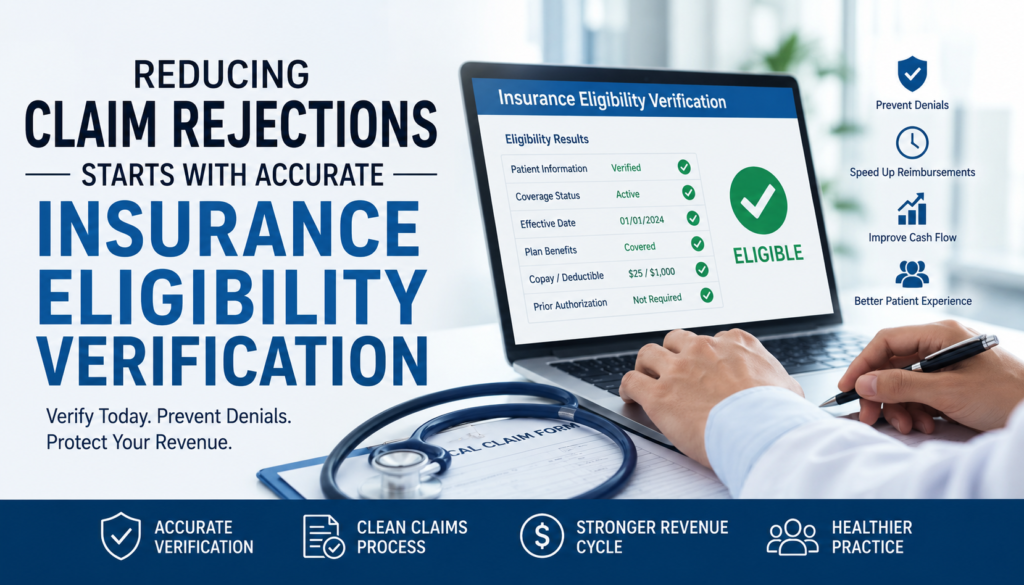
At its core, insurance eligibility verification confirms whether a patient’s coverage is active and whether the planned services are covered under their current benefits.
Simple enough on paper.
But healthcare rarely behaves neatly. Coverage changes mid-year. Employers switch plans quietly. Deductibles reset in January, and suddenly everyone seems surprised at once. Some services need prior authorization. Others require referrals. A patient may technically have insurance while still carrying out-of-network limitations that completely alter reimbursement.
This is where accurate verification matters. Not rushed verification. Accurate verification.
Done properly, the process helps practices confirm:
Without that clarity, claims often enter the system already wounded a little. Sometimes fatally.
The team at Concierge Practice Solutions works closely with practices, navigating these exact challenges through streamlined billing and revenue cycle support. And honestly, this part of the workflow tends to deserve far more attention than it gets.
Bottom line first: Many claim rejections are preventable.
Not all denials come from coding errors or payer disputes. A surprising number originate from missing or incorrect eligibility details gathered before the appointment ever happened.
Inactive policies are common. So are mismatched subscriber IDs, outdated group numbers, and authorization gaps.
Tiny errors. Expensive consequences.
According to the Centers for Medicare & Medicaid Services, administrative inefficiencies continue to create significant financial strain across healthcare systems. Eligibility mistakes may seem minor individually, but they compound quickly when multiplied across dozens of appointments each week.
And the emotional cost inside practices is real, too, though people rarely talk about that part.
Because every rejected claim creates extra labor. More calls. More follow-ups. More uncomfortable patient conversations at checkout. Eventually, staff burnout begins creeping in through side doors no one noticed were open.
Oddly enough, many practices don’t realize how much time they spend fixing avoidable revenue leaks until someone maps the workflow step by step.
That’s usually an uncomfortable afternoon.
Yes, insurance eligibility verification helps reduce claim rejections. But the deeper value is operational stability.
A practice that verifies benefits carefully tends to experience smoother patient communication, fewer billing surprises, and stronger cash flow consistency. The atmosphere changes a little too. Less scrambling. Fewer last-minute corrections.
Patients notice that.
Nobody enjoys arriving for an appointment only to discover their insurance information was incomplete, or their service requires unexpected authorization. Trust erodes quickly in moments like that, even when the medical care itself is excellent.
Healthcare is emotional already. Financial confusion only amplifies it.
This is one reason many practices now integrate eligibility verification directly into broader revenue cycle management workflows instead of treating it as a disconnected front-desk task.
The systems work better when the handoffs are cleaner. Quietly. Consistently.
A clean claim is simply a claim submitted the first time correctly, without errors that delay processing or reimbursement.
That definition sounds almost suspiciously optimistic some days.
Still, clean claims remain one of the strongest indicators of billing efficiency. And eligibility verification plays a larger role in that outcome than many newer practices expect.
Here’s why.
When insurance details are validated before services are rendered, billing teams can:
The result is fewer interruptions downstream.
Not perfection. Healthcare billing probably abandoned perfection years ago. But smoother movement through the revenue cycle matters enormously, especially for independent practices operating with lean teams.
Practices investing in proactive verification processes often see improvements in:
Those improvements rarely happen overnight. They accumulate slowly. Quietly.
Then, one month, leadership realizes cash flow no longer feels quite so unpredictable.
Smaller healthcare organizations usually feel this pressure most intensely because staff members wear multiple hats all day long.
The same person answering phones may also handle scheduling, intake paperwork, insurance checks, and patient billing questions before lunch.
That’s a lot of cognitive switching for work requiring precision.
And eligibility verification has become more complicated over time, not less. Insurance plans shift constantly. Payer portals behave differently. Authorization rules evolve with very little warning.
Even highly capable staff can miss details under those conditions.
This explains why some practices eventually outsource portions of the billing and verification process through specialized medical billing and RCM support services. Not because internal teams are failing, necessarily. More because administrative complexity keeps expanding while appointment schedules remain packed.
There’s only so much bandwidth inside a workday.
This part gets overlooked.
Patients may not understand revenue cycle management terminology, but they absolutely understand confusion. They understand surprise bills. Delayed approvals. Repeated paperwork requests.
And unfortunately, many patients assume billing problems reflect the overall quality of care.
Fair or unfair, that connection happens.
Accurate eligibility verification helps practices create smoother patient experiences by clarifying costs early, identifying coverage issues before treatment, and reducing unexpected denials later on.
That kind of transparency builds trust slowly. Which is how most meaningful trust develops anyway.
Not through slogans. Through fewer avoidable problems.
The American Medical Association has repeatedly highlighted how administrative burdens affect both providers and patients alike. Streamlining verification processes may sound operational, but the ripple effects reach much further than spreadsheets.
That may be the strangest truth about effective insurance eligibility verification.
When it works well, nobody notices it.
Appointments move smoothly. The claims process is faster. Patients ask fewer confused questions. Staff members spend less time chasing corrections weeks later.
Quiet systems are often healthy systems.
Of course, no workflow eliminates every denial. Insurance billing remains messy in ways few outsiders fully appreciate. But reducing claim rejections starts with creating cleaner information before the claim is ever submitted.
And that begins with verification done carefully. Not hurriedly.
Sometimes the most important parts of healthcare operations are the least visible ones. The small checks are completed before anyone enters the exam room. The extra few minutes spent confirming details nobody remembers unless something goes wrong.
Which, in billing, tends to happen more often than people expect.